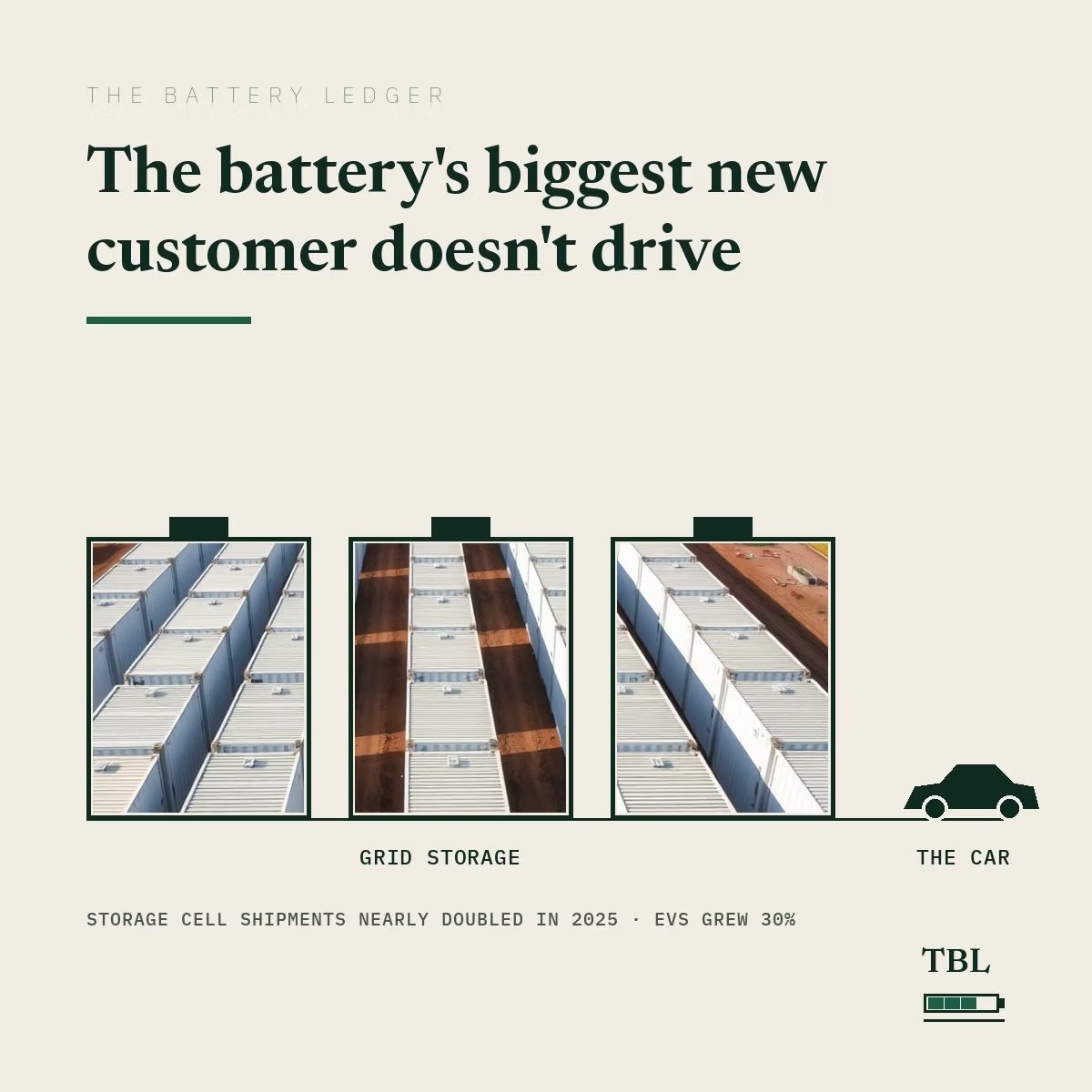
The battery’s biggest new customer doesn’t drive
For fifteen years “a good battery” has meant whatever a car needs. The customer arriving now has different priorities.
The share nobody watches
Buried in the IEA’s Global EV Outlook this year is a quiet number. Electric vehicles accounted for more than 70 per cent of global battery deployment in 2025, down from almost 80 per cent in 2024. EV demand didn’t shrink, it grew almost 30 per cent to 1.2 terawatt hours. Something else simply grew much faster.
That something is stationary storage. The IEA calls battery storage the fastest growing power technology in the world: 108 gigawatts added in 2025, 40 per cent up on 2024, and an installed base eleven times what it was in 2021. On a different measure, cell shipments, InfoLink puts storage cells at 612 gigawatt hours in 2025, nearly double the year before, with 801 forecast for 2026. And in the United States, stationary storage was already a third of all battery deployment last year, with the IEA noting deployments expanding across power grids and data centres.
Different customer, different battery
Here’s why that matters more than the volumes. A car wants energy density, low weight, range. A grid battery in a field, or behind a data centre, puts far less value on any of those. What it pays for is cost per cycle, a long life, and above all not catching fire. It’s a different definition of good.
You can already watch the definition changing hands. Lithium iron phosphate, the chemistry long treated as the budget option for cars, now makes up around 90 per cent of new storage deployments per the IEA, up from under half five years ago. Sodium-ion’s largest order to date, the 60 gigawatt hour agreement between CATL and HyperStrong, is a storage order. And in the US, more than 50 gigawatt hours of manufacturing capacity from names like LG Energy Solution and Ford was reallocated toward LFP in 2025, largely aimed at the storage market. Battery factories built for cars are being retooled for the grid.
Why this is good news almost everywhere
It’s hard to find a villain in this story. Carmakers keep their supply. Cell makers gain a second customer that buys in gigawatt-hour blocks on long contracts. The chemistries everyone wrote off as unglamorous, LFP, sodium-ion, and the technologies being developed for longer-duration storage, stop being the cheap seats and become the product. And the grid gets what it has always wanted, storage at a price that finally works.
What this doesn’t establish
EVs are still the clear majority of battery demand and will be for years, so this is about where growth and design priorities are shifting, not about cars shrinking. The 2026 figures are forecasts. And storage demand has policy exposure of its own, especially in the US.
The Ledger
Every battery story of the last decade has been told through the car: range, charging, gigafactories named after vehicles. My read is that the more important customer of the next decade doesn’t drive. The definition of the best battery is quietly moving from weight and range to cost, cycles and safety, and once the volume buyer scores it that way, the companies that look best are not the ones the car story flattered.
So here’s the question: if you were designing a battery company from scratch today, would you build it for the car, or for the building next to it?
Sources
IEA Global EV Outlook 2026 on EV share of battery deployment in 2024 and 2025, 2025 EV deployment, the US stationary storage share and the LFP capacity reallocation. IEA Global Energy Review 2026 on 2025 storage additions, the growth rate, the installed base multiple and LFP’s share of storage deployments. InfoLink Consulting, via trade press, on 2025 storage cell shipments and the 2026 forecast. CATL announcement, April 2026, on the 60 GWh HyperStrong agreement.
Read next
All insights →


 Newest on The RegisterDr Francisco TrinidadFormer Director of Battery Technology, Exide · Alpha Beta SocietyRead the profile →