How Lead Batteries Work, and Where They Still Win
Lithium has taken the applications that reward energy density. Lead retains the ones that reward cost, cold-cranking power and a closed loop.
Sources: US Geological Survey, Mineral Commodity Summaries 2026, lead chapter (February 2026); International Lead and Zinc Study Group, October 2025 forecasts, as cited by the USGS; US Final 2025 List of Critical Minerals, Federal Register 90 FR 50494; US Environmental Protection Agency.
Lead-acid was the first rechargeable battery chemistry to reach commercial use, and in the United States it is the most recycled product of any kind. Lithium has taken the applications that reward energy density. Lead retains the ones that reward cost, cold-cranking power and a closed material loop.
How The Chemistry Works
The following section is standard electrochemical background rather than reporting from the sources cited above.
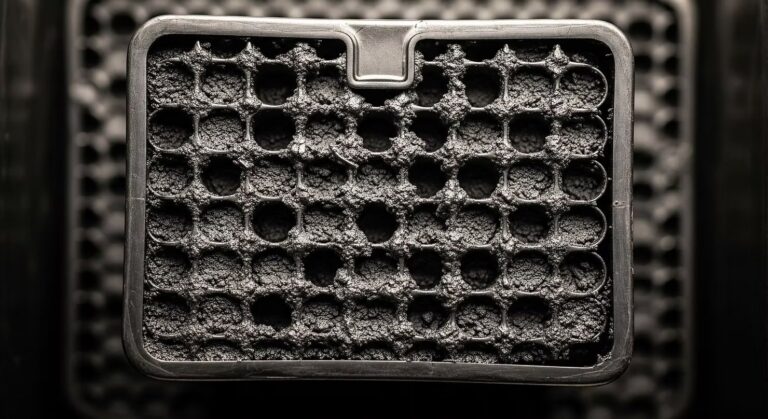
A lead-acid cell has a lead dioxide positive plate, a metallic lead negative plate and a sulfuric acid electrolyte. On discharge, both plates convert to lead sulfate and the acid dilutes towards water. On charge, the reaction runs backwards. The nominal voltage of a single cell is around 2V, which is why six cells in series give the familiar 12V automotive battery.
Two consequences follow from that chemistry, and they explain most of what lead is and is not good at.
The electrolyte is part of the reaction. Sulfuric acid is consumed on discharge, which means state of charge can typically be read directly from electrolyte density. That is a practical advantage for maintenance and diagnostics that lithium chemistries do not offer as simply.
Lead sulfate crystals harden if left too long. A battery held in a partially discharged state develops coarse sulfate crystals that no longer dissolve readily on charging. This is sulfation, and it is a principal failure mode, though not the only one. Published work on valve-regulated cells under deep cycling attributes failure in that duty primarily to softening and shedding of the positive active mass rather than to sulfation, so the dominant mechanism depends on how the battery is used. Sulfation also helps explain why deep-cycle and starter batteries are built so differently despite sharing a chemistry.
The Main Construction Types
Flooded. Free liquid electrolyte, vented. The cheapest and still the most common. Requires an upright orientation and, in some designs, periodic topping up with water.
VRLA. Valve-regulated lead-acid, sealed and maintenance-free, in two forms. AGM holds the electrolyte in an absorbent glass mat separator. Gel immobilises it in a silica gel. Both allow orientation flexibility and lower gassing, at higher cost.
EFB. Enhanced flooded batteries sit between standard flooded and AGM, with improved cycling durability at lower cost than AGM.
Where Lead Still Wins
Starting, lighting and ignition
The USGS records that lead-acid batteries were used primarily as starting-lighting-ignition (SLI) batteries for automobiles, as industrial-type batteries for standby power for computer and telecommunications networks, and for motive power. The USGS does not rank these three by volume.
Standby and backup power
The USGS identifies standby power for computer and telecommunications networks as a principal industrial use.
Motive power
Forklifts and other industrial vehicles benefit from a battery that is heavy, because the weight doubles as counterbalance ballast. It is one of the few applications where lead’s mass is a feature.
Cost and recyclability
Lead is cheap. S&P Global Platts Metals Week data reported by the USGS put the average North American lead price for the first ten months of 2025 at 106 cents per pound, 3% below the 2024 annual average of 108.8 cents.
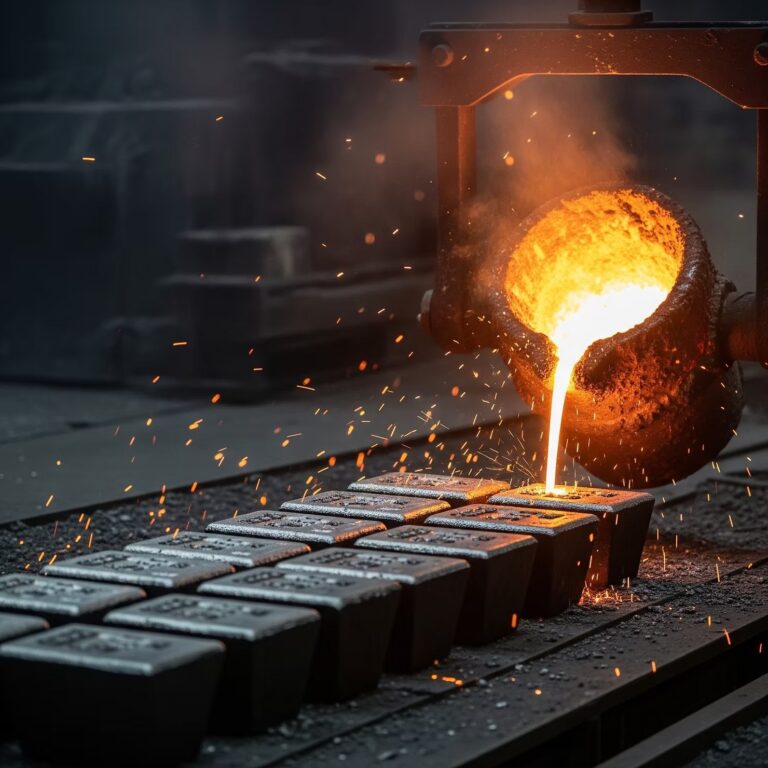
The material loop is unusually closed. The USGS estimates that 1 million tonnes of secondary lead was produced in the United States in 2025, an amount it describes as equivalent to 70% of apparent domestic consumption, and reports that nearly all of it came from old scrap, mostly lead-acid batteries. The EPA, using 2018 data, states that the United States recycles lead-acid batteries the most out of all products, at 99% of generation, and notes that recycling rates for other battery chemistries are not as well tracked.
Since the last US primary lead refinery closed in 2013, and nearly all domestically mined lead concentrate has been exported, the American refined lead industry is effectively a recycling industry.
Where Lead Loses
Energy density is the decisive constraint. A lead-acid battery typically stores in the region of 30 to 40 Wh/kg, against roughly 150 Wh/kg and upwards for commercial lithium chemistries.2
Cycle life under deep discharge is the second constraint. Lead is generally less tolerant of repeated deep cycling than LFP.
Lead Is Now A Critical Mineral
On 7 November 2025 the US Final 2025 List of Critical Minerals was published in the Federal Register (90 FR 50494). The final list runs to 60 minerals and added ten. Six of those, including lead, were added on the basis of the USGS’s updated methodology, alongside copper, potash, rhenium, silicon and silver. Four more, boron, metallurgical coal, phosphate rock and uranium, were added following public comment and interagency input.
The Market Is Mature, Not Shrinking
The International Lead and Zinc Study Group, cited by the USGS, forecast global refined lead production at 13.3 million tonnes in 2025 and consumption at 13.25 million tonnes, both slight increases. World mine production was estimated at 4.5 million tonnes, against 4.6 million tonnes in 2024, with China the largest producer at an estimated 1.9 million tonnes. Identified world lead resources total more than 2 billion tonnes.
Note that these are different measures. Refined production includes secondary output and is therefore much larger than mine production; the two figures should not be compared directly. The picture is also not uniform by geography: US apparent consumption fell from 1.64 million tonnes in 2021 to an estimated 1.5 million tonnes in 2025, though it rose 8% year on year in 2025.
Scrap Flows Are A Live Commercial Question
The USGS records that 23 million spent SLI lead-acid batteries were exported from the United States in the first eight months of 2025, which it describes as a 23% increase on the 19 million exported in the same period of 2024.3
Common Misconceptions
“Lead-acid is obsolete technology.” It is mature, which is different. AGM and EFB are later developments than the flooded design, and maturity means slow incremental improvement rather than stasis.
“Lead batteries are unsafe because lead is toxic.” Lead is toxic, and recycling must be properly controlled, which is precisely why the regulatory framework around it is as developed as it is. The EPA notes that pyrometallurgical recycling, the most common method, emits airborne lead particles that can contaminate the surrounding area without proper emissions controls, and that US recyclers operate under strict permitting requirements. The batteries themselves are industrial products handled almost entirely through commercial channels rather than by consumers; VRLA types are sealed, while the more common flooded type is vented.
“Recycled lead is lower quality.”
Key Takeaways
- The lead-acid battery industry accounted for an estimated 67% of US apparent lead consumption in 2025, according to the USGS.
- Secondary, or recycled, lead was an estimated 1 million tonnes in the United States in 2025, slightly below the 1.03 million tonnes estimated for 2024. The USGS describes this as equivalent to 70% of apparent domestic consumption, and reports that nearly all of it came from old scrap, mostly lead-acid batteries.1
- The United States has had no primary lead refinery since 2013. Domestic refined supply is a recycling industry, not a mining one.
- Lead was added to the US critical minerals list on 7 November 2025.
- Global refined lead production was forecast at 13.3 million tonnes for 2025 by the International Lead and Zinc Study Group, as cited by the USGS.
Notes
- The USGS states 70%. Its own salient statistics table for 2025 gives secondary refinery output from old scrap of 1,000 thousand tonnes against apparent consumption of 1,500 thousand tonnes, which is 67%. That division is ours. We report the USGS figure and flag the discrepancy rather than reconciling it.
- These ranges are widely cited textbook values. We were not able to verify either figure against a government or peer-reviewed source read at origin, and flag them accordingly.
- 23 million against 19 million is a 21% increase. The USGS states 23%, which presumably reflects unrounded underlying figures. We report the USGS figures as published.
- US Geological Survey, Mineral Commodity Summaries 2026, lead chapter, February 2026. Source of all US production, consumption, recycling, trade and critical minerals listing figures cited above. The price figure originates with S&P Global Platts Metals Week and is reported by the USGS.
- International Lead and Zinc Study Group, session forecasts press release, 13 October 2025, as cited by the USGS. Source of the global refined production and consumption figures. Not consulted directly.
- US Final 2025 List of Critical Minerals, Federal Register 90 FR 50494, 7 November 2025.
- US Environmental Protection Agency, Battery Collection in Action Case Study: The Lead-Acid Battery Collection Network, last updated September 2025, citing EPA’s 2018 Advancing Sustainable Materials Management data. Source of the 99% US recycling rate.
- Journal of Power Sources, studies on valve-regulated lead-acid failure modes. Abstract only; cited as a qualifier on the sulfation claim rather than as a primary basis for it.
Read next
All insights →
 Newest on The RegisterDr Francisco TrinidadFormer Director of Battery Technology, Exide · Alpha Beta SocietyRead the profile →