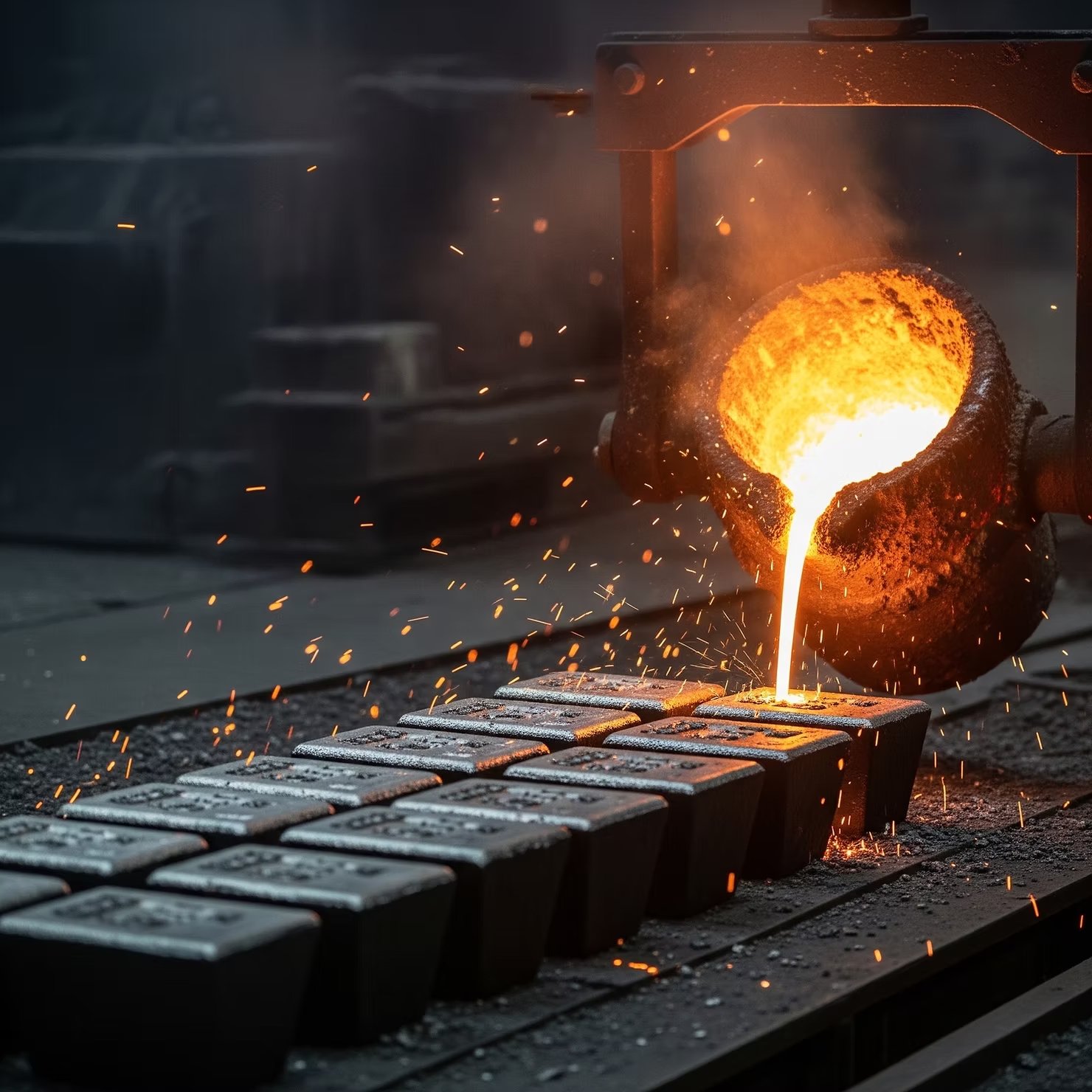
Why the US Refined Lead Industry Now Runs on Scrap
Circularity is a genuine strategic asset for lead. It is not the same thing as self-sufficiency.
Source: US Geological Survey, Mineral Commodity Summaries 2026.
Advanced lead-acid batteries retain a durable position in the global battery market, and the reason is structural rather than sentimental. Globally, that position rests on both mining and recycling. In the United States, it rests almost entirely on recycling, for reasons specific to that market.
The US Geological Survey reports that the last US primary lead refinery closed in 2013, and that nearly all domestically mined lead concentrate has been exported since. In 2025 the country produced no primary refined lead. It produced an estimated 1 million tonnes of secondary refined lead from old scrap, an amount equivalent to 70% of apparent domestic consumption. Nearly all of that came from old scrap, mostly lead-acid batteries.
The USGS put the value of secondary lead produced in 2025 at $2.4 billion, against $650 million for recoverable lead from ore mined domestically. Both figures fell year on year, by 4% and 8% respectively. The comparison reflects the absence of domestic primary refining rather than any judgement about the two activities: US mines produce concentrate that is refined elsewhere, so their output is valued at a different point in the chain.
Where The Demand Sits
The lead-acid battery industry accounted for an estimated 67% of US apparent lead consumption in 2025, according to the USGS. The applications it lists are starting-lighting-ignition batteries for automobiles, industrial batteries providing standby power for computer and telecommunications networks, and motive power.
Those are the segments where reliability, cost and lifecycle economics matter more than energy density, and they have not been displaced.
The Market Is Stable, Not Shrinking
The International Lead and Zinc Study Group, cited by the USGS, forecast global refined lead production at 13.3 million tonnes in 2025 and refined lead consumption at 13.25 million tonnes, both slight increases on the previous year. Supply and demand are closely matched.
World mine production was an estimated 4.5 million tonnes in 2025, against 4.6 million in 2024. China was by far the largest producer at an estimated 1.9 million tonnes. World reserves stand at 95 million tonnes, and identified resources exceed 2 billion tonnes.
Pricing was flat to slightly soft. The USGS records an average North American lead price of 106 cents per pound over the first ten months of 2025, 3% below the 2024 annual average of 108.8 cents. Global stocks in LME-approved warehouses stood at 217,000 tonnes at the end of October 2025, 10% below the level at the end of 2024.
The Ledger
Three developments deserve attention from anyone with exposure to this supply chain.
Lead is now a critical mineral. The USGS records that the US Final 2025 List of Critical Minerals was published in the Federal Register on 7 November 2025, and that lead was among the additions, alongside copper, potash, rhenium, silicon and silver. The change followed an updated USGS methodology. Critical mineral designation brings permitting attention, funding eligibility and supply chain scrutiny that a mature industrial commodity does not otherwise attract.
Import reliance rose in 2025. US net import reliance for refined lead rose to 33% from 27% in 2024, on USGS figures. Apparent consumption rose 8% over the same period, while domestic mine production of recoverable lead fell 9%, which the USGS attributes to several lead-producing mines reducing output. On the five-year series the USGS publishes, US mine production has moved between 263,000 and 296,000 tonnes of recoverable lead since 2021, so a single year’s movement should not be read as a trend. Refined metal imports came predominantly from Canada at 31%, the Republic of Korea at 16%, Mexico at 15% and Australia at 13% over the 2021 to 2024 period.
Scrap is leaving the country. In the first eight months of 2025, the USGS records that 23 million spent SLI lead-acid batteries were exported from the United States, a 23% increase on the 19 million exported in the same period of 2024. For an industry whose feedstock is its own previous output, where end-of-life batteries go is a commercial and regulatory question, not a housekeeping one. A recycling-based refining industry that exports a growing share of its raw material is worth watching.
Taken together, these describe a market that is stable but not self-contained. Global refined production and consumption are closely matched and world mine production is broadly flat, at an estimated 4.5 million tonnes against 4.6 million in 2024. Primary supply remains the foundation of the global lead market, and reserves of 95 million tonnes and resources above 2 billion tonnes indicate no constraint on that.
What the US figures show is a specific structural feature of one market: refining capacity that depends on scrap because primary refining left, alongside rising import reliance and growing exports of that same scrap. Circularity is a genuine strategic asset for lead. It is not the same thing as self-sufficiency, and it does not substitute for primary supply at a global level.
Key Figures
US Geological Survey, Mineral Commodity Summaries 2026, lead chapter, prepared by Kateryna Klochko, published February 2026. Global refined production and consumption figures sourced by the USGS to the International Lead and Zinc Study Group, October 2025 forecasts. Price data sourced by the USGS to S&P Global Platts Metals Week. All tonnages are metric tonnes. The USGS defines apparent consumption for lead as secondary refined production from old scrap plus refined imports minus refined exports.
Read next
All insights →

 Newest on The RegisterDr Francisco TrinidadFormer Director of Battery Technology, Exide · Alpha Beta SocietyRead the profile →