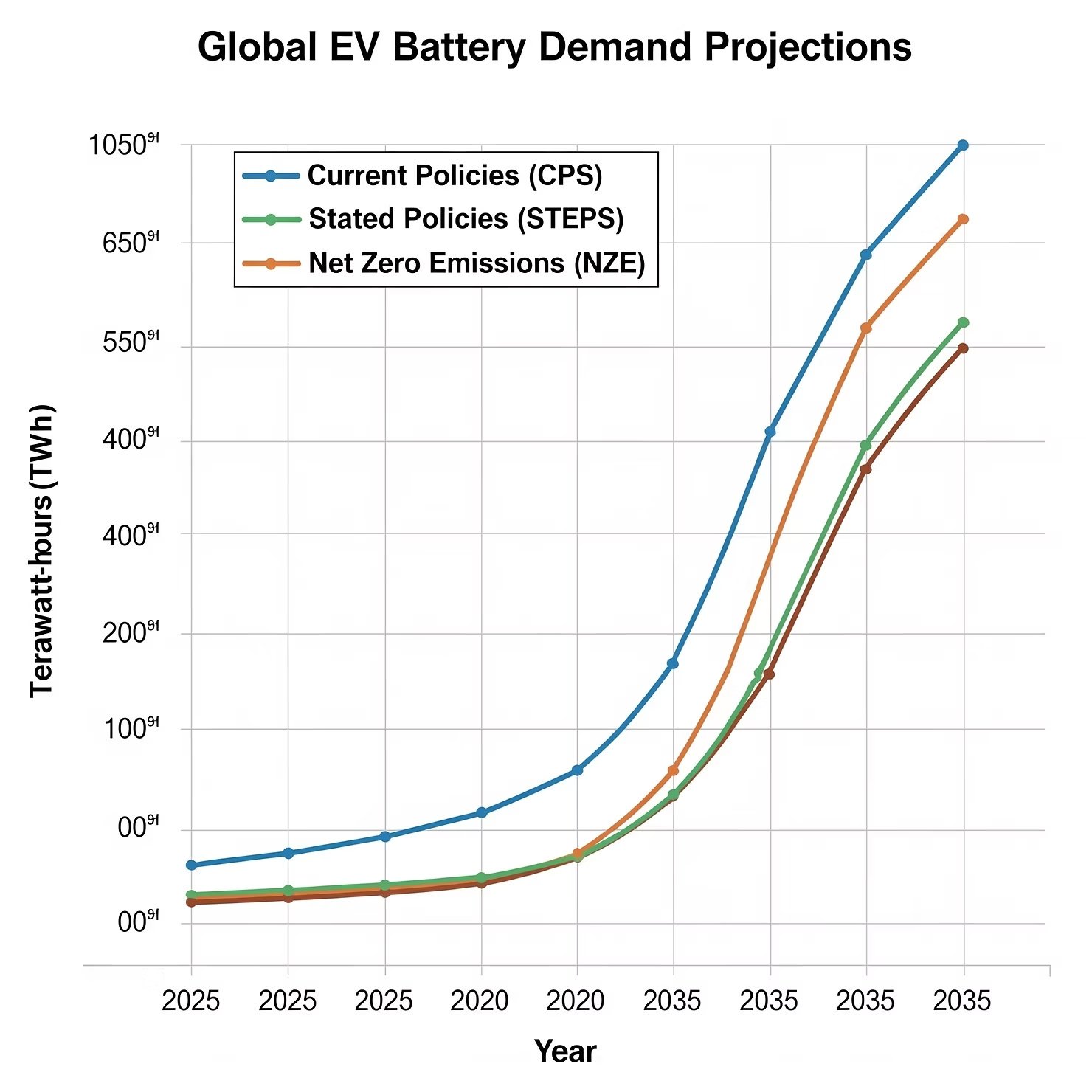
IEA Scenarios Point to EV Battery Demand More Than Tripling by 2035
Demand more than triples by 2035 in both main scenarios. Whether the industry outside China can serve it is a separate question.
Source: International Energy Agency, Global EV Outlook 2026.
Global EV battery demand more than triples by 2035 in both of the IEA’s main scenarios, though the two diverge by around a terawatt-hour, and the agency presents these as scenarios rather than forecasts.
EV battery deployment reached 1.2 TWh in 2025, an increase of almost 30% on 2024 and more than seven times the 2020 level, according to the IEA. Electric vehicles accounted for more than 70% of total global battery deployment in 2025, slightly down from almost 80% in 2024.
What The Scenarios Say
By 2030, the IEA expects EV battery deployment to reach almost 3 TWh under both its Current Policies Scenario and its Stated Policies Scenario.
The two diverge after that. By 2035, deployment reaches around 4 TWh under the Current Policies Scenario and almost 5 TWh under the Stated Policies Scenario. The difference between the two is the value of policy that has been announced but not yet enacted.
A third scenario, Net Zero Emissions, reaches around 9 TWh by 2035, almost double the STEPS level. NZE is not a projection of expected outcomes. It describes the deployment that would be required to meet net zero, and the IEA characterises the gap between it and the policy scenarios as significant.
Where The Growth Sits, And Where It Does Not
Electric cars continue to drive demand in both scenarios, but the composition shifts. The IEA projects electric trucks accounting for around 10% of total EV battery deployment in both 2030 and 2035 under CPS and STEPS, up from 8% in 2025. Truck battery demand more than doubled in 2025, largely on a sharp acceleration in Chinese sales.
Under STEPS, the share of emerging markets and developing economies other than China rises from around 6% of global EV battery deployment in 2025 to about 15% by 2035, driven primarily by uptake in Southeast Asia, India and Latin America. China itself accounted for 60% of global EV battery deployment in 2025 and is counted separately.
The picture is not uniformly upward. Under CPS, the IEA projects the United States seeing the sharpest decline in share of any major market, from around 10% in 2025 to less than 5% in both 2030 and 2035, reflecting slower growth relative to other markets. US deployment stagnated in 2025 while China and the European Union expanded.
The Ledger
Growth of this scale is a manufacturing and supply chain question before it is a demand question, and the same IEA chapter is candid about where the constraints sit.
Global nameplate lithium-ion manufacturing capacity passed 4 TWh by the end of 2025, up roughly 30% on 2024. But China accounts for over 80% of that total, with the European Union and United States at 6 to 7% each. Chinese producers supplied almost 75% of global electric car battery deployment in 2025, and over half the European Union market, nearly double their 2023 share there.
Capacity alone does not solve it. The IEA notes that most facilities take more than five years from starting operations to approach nominal output, and that battery production costs in Europe and the United States remain as much as 50% higher than in China before public support is counted. Competing requires production yields above 90%.
The financial position is tighter than the demand outlook suggests. The IEA reports that several leading non-Chinese producers have depended on policy support for profitability, citing LG Energy Solution’s 2024 earnings, which would have been negative without US tax credits. Several automakers have scaled back or withdrawn from supply agreements.
So the scenarios describe demand that more than triples. Whether the industry outside China is positioned to serve it is a separate question, and on the IEA’s own evidence an open one.
Key Figures
International Energy Agency, Global EV Outlook 2026, electric vehicle batteries chapter. CPS is the Current Policies Scenario, STEPS the Stated Policies Scenario and NZE the Net Zero Emissions Scenario. These are scenarios under differing policy assumptions, not forecasts. Battery deployment is defined by the IEA as volume-weighted average battery size multiplied by vehicle sales, by mode and region.
Read next
All insights →

 Newest on The RegisterDr Francisco TrinidadFormer Director of Battery Technology, Exide · Alpha Beta SocietyRead the profile →