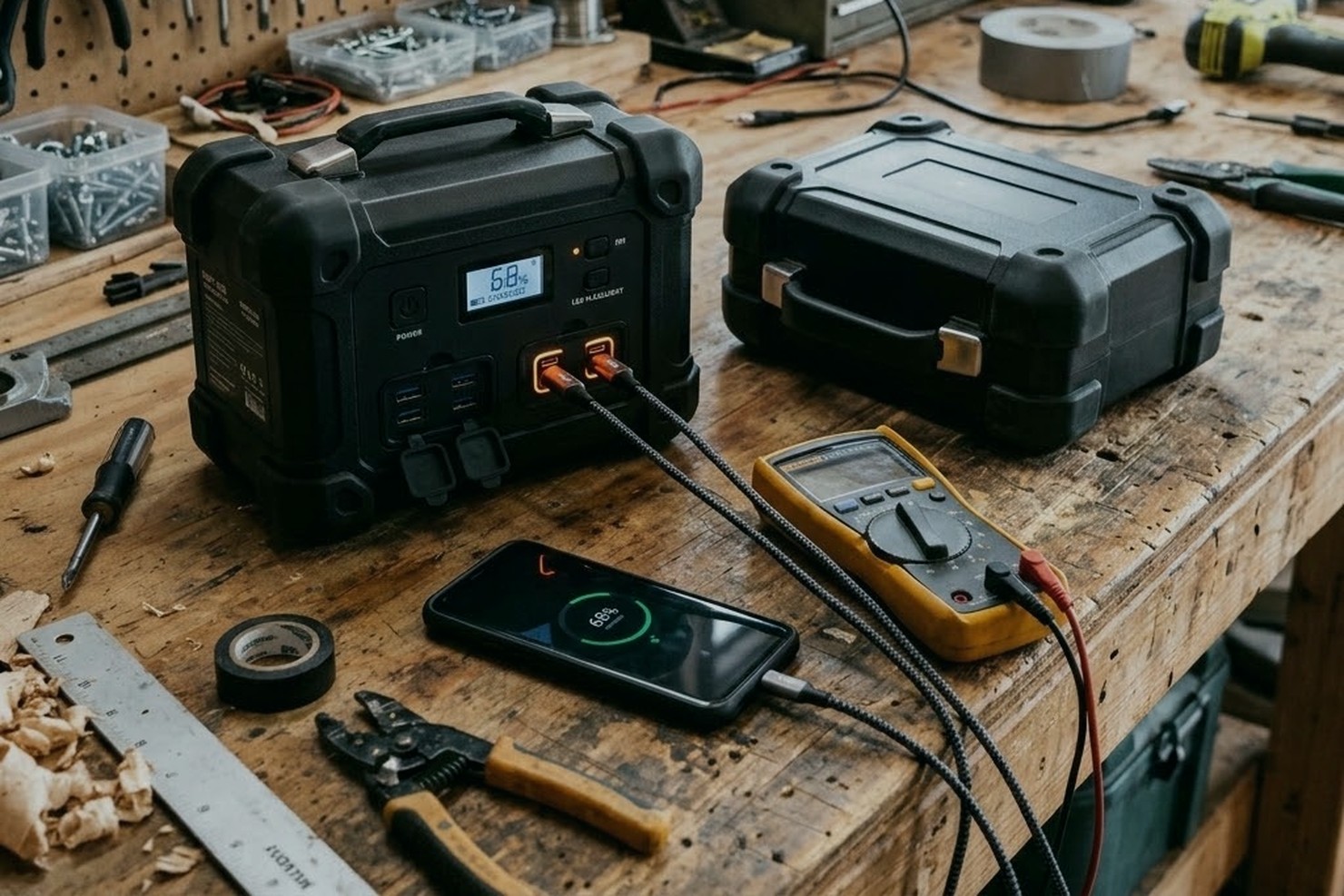
EnerSys Makes Its Defence Ambitions Concrete With Ultralife
EnerSys has agreed to buy Ultralife for $16 a share in cash, in a deal with an enterprise value of about $320 million. The price is the headline. The more telling detail is what EnerSys says it is buying: defence capability, permitted US manufacturing capacity, and batteries designed for conditions where the cheapest kilowatt-hour is not the point.
On 27 October, EnerSys, the Pennsylvania-based stored energy company, signed an agreement to acquire Ultralife, the New York battery and communications maker. The $16 a share is 166% above Ultralife’s closing price of $6.01 the day before the announcement.
The two headline numbers measure different things. The $16 a share is what Ultralife’s shareholders would receive; on our arithmetic, the 16.7 million shares outstanding come to about $267 million. The roughly $320 million is the deal’s enterprise value. EnerSys’s offer document puts the total funding needed, which also covers payments for employee equity awards and repaying Ultralife’s existing credit agreement, at about $320 million, plus related fees and expenses.
What was agreed
The acquisition is structured in two steps. EnerSys launched a cash tender offer for all Ultralife shares on 28 October, due to expire at 5pm New York time on 3 December unless it is extended. If more than half of Ultralife’s shares are tendered and the other conditions are met, EnerSys’s acquisition subsidiary, EnerSys Mergersub, will merge into Ultralife without a shareholder vote, as Delaware law allows. Ultralife would survive as a wholly owned EnerSys subsidiary and leave the stock market.
The other conditions are mainly regulatory. The US antitrust waiting period must expire, and the deal needs clearance under the United Kingdom’s National Security and Investment Act; Ultralife has operations in Britain. The companies expect to complete in the first quarter of 2027. If that slips, the agreement allows until 27 April 2027, with two possible 60-day extensions if only regulatory clearances remain outstanding.
Each side could owe the other $10.3 million if the deal falls through, but in different circumstances. Ultralife’s fee applies in specified situations including a change in its board’s recommendation, termination to accept a superior proposal, and certain deals that follow a competing proposal. EnerSys’s reverse fee applies in specified situations including the outside date passing with only antitrust or national security clearances outstanding, a final legal block under those laws, or EnerSys failing to complete once all conditions are met.
Ultralife’s board has unanimously recommended that shareholders accept. A group of supporting shareholders, comprising its chair, Bradford Whitmore, and associated holders, together owned about 40.3% of the shares and have agreed to tender them. On its own, that is not enough to meet the majority condition.
EnerSys’s press release says the deal will be funded from cash on hand. Its more detailed offer document refers to cash on hand and borrowings under its existing credit facilities. Either way, the offer has no financing condition.
What EnerSys is buying
Ultralife makes rechargeable and non-rechargeable batteries, battery systems and accessories for military communications and other specialised uses, alongside a communications and electronics business. It reported $191 million of revenue in 2025, employs more than 700 people, and has its principal operations in the US, Canada, the UK and China.
Defence is only part of that business. In 2025, Ultralife’s commercial sales were about $125.3 million and its government and defence sales about $65.9 million, so defence made up roughly 34% of revenue. Alongside the defence capability, EnerSys would be acquiring an established commercial business.
EnerSys gives four reasons for the deal. It wants more of the defence market, naming munitions, soldier power, drones, counter-drone systems and autonomous systems. It points to Ultralife’s manufacturing capacity, which it describes as purpose-built and holding existing security and environmental permits. It wants Ultralife’s operational expertise to help scale production of EnerSys’s own liquid reserve battery technology. And it says the combination creates a broader product range compliant with US rules on foreign entities of concern, or FEOC.
EnerSys does not say which FEOC rules it has in mind, and its announcement does not set out how compliance is established for each Ultralife product. One relevant example is the 2025 tax law that amended Section 45X, the advanced manufacturing production credit: a component that includes “material assistance” from a “prohibited foreign entity” no longer counts as eligible for the credit. That is a test for one tax credit. It is not a general certificate of compliance with every rule that uses similar language.
Mark Matthews, EnerSys’s chief technology officer and president of Precision Power Solutions, put the technical case directly. Ultralife’s products, he said, offer “very high energy density, long shelf life, low self-discharge, useful pulse power, and cold-weather performance.” Shawn O’Connell, EnerSys’s chief executive, described the aim as serving “the increasingly electrified battlefield of the future.”
EnerSys expects to reach $15 million to $20 million a year in run-rate cost savings within 18 months. It also expects the deal to add to its adjusted earnings per share within about 18 months of closing, excluding transaction and integration costs and other non-recurring items. Both are the company’s own projections.
The deal continues a direction EnerSys has already signalled. In July, as we reported in August, it scaled back its planned US lithium-ion cell plant to about 1 GWh and refocused it on aerospace, defence and specialised industrial uses.
How the price was reached
The offer document sets out the key meetings and events behind the negotiation in unusual detail, while noting that it does not catalogue every conversation. EnerSys first raised a possible acquisition in a video call on 26 January. In April, Ultralife’s chief executive said it was not the right time to explore a sale. When the two sides met again in June, Whitmore said he would expect a significant premium before considering one.
In July, EnerSys made a written, non-binding approach at $12 to $14 a share. Over September it narrowed that to $13.75 to $14. On 1 October, Ultralife’s board countered at $18. On 7 October, EnerSys said it would not support a deal above $15.50. Two days later, Ultralife proposed $16. The two sides settled there, and signed on 27 October.
The scale of it
For EnerSys, this is a targeted purchase rather than a transformation. In its financial year to 31 March 2026, EnerSys reported net sales of about $3.75 billion, so on our arithmetic Ultralife’s revenue would add roughly 5%. The enterprise value is about 1.7 times Ultralife’s 2025 revenue. Both comparisons set Ultralife’s calendar-year 2025 figures against EnerSys’s financial year, so the periods differ. As of early July, EnerSys held about $530.7 million in cash.
The Ledger
Defence demand for batteries is specific. It values shelf life, cold-weather performance and the ability to deliver sharp bursts of power, often in small volumes and under strict sourcing rules. That is a different business from the race to the cheapest cell, and EnerSys is buying its way further into it. It is paying primarily for differentiated capability, permitted manufacturing capacity and access to specialised defence markets, rather than making a transformational acquisition for scale alone. The negotiation suggests Ultralife’s board knew the value of all three. Until the tender closes and the regulators clear it, this is an agreement rather than a combination. If it completes, it will be one of the clearer signs yet that the established battery companies see defence as a market in its own right.
EnerSys, Form 8-K and press release (Exhibit 99.1), 27 October 2026 (terms, conditions, termination fees and their triggers, support agreement, strategic rationale, quotations, synergy and earnings expectations). EnerSys Mergersub Inc., Offer to Purchase filed with Schedule TO, 28 October 2026 (offer timetable, conditions, funding, share prices and share count, background of the negotiation, EnerSys financial position). Ultralife Corporation, Annual Report on Form 10-K for 2025 (commercial and government/defence sales). Internal Revenue Service, Notice 2026-15, February 2026 (Section 45X prohibited foreign entity restriction enacted by Public Law 119-21). The Battery Ledger, “The old battery companies are quietly going multi-chemistry”, August 2026 (EnerSys lithium plant, citing EnerSys’s announcement of 23 July 2026).
Read next
All insights →


 Newest on The RegisterDr Francisco TrinidadFormer Director of Battery Technology, Exide · Alpha Beta SocietyRead the profile →