UK Call for Evidence on Community Batteries Targets Renters and Flats
The government wants shared storage to reach the households that cannot install a battery of their own.
Sources: GOV.UK and the International Energy Agency.
The UK government launched a call for evidence on community battery storage on 4 June 2026, in a market it describes as currently underdeveloped. The exercise is published by the Department for Energy Security and Net Zero.
What The Government Is Asking
The call for evidence seeks views on how to scale up deployment, remove regulatory and commercial barriers, ensure safety, and make sure benefits reach those unable to install their own battery, a group the government identifies as including renters and people living in flats.
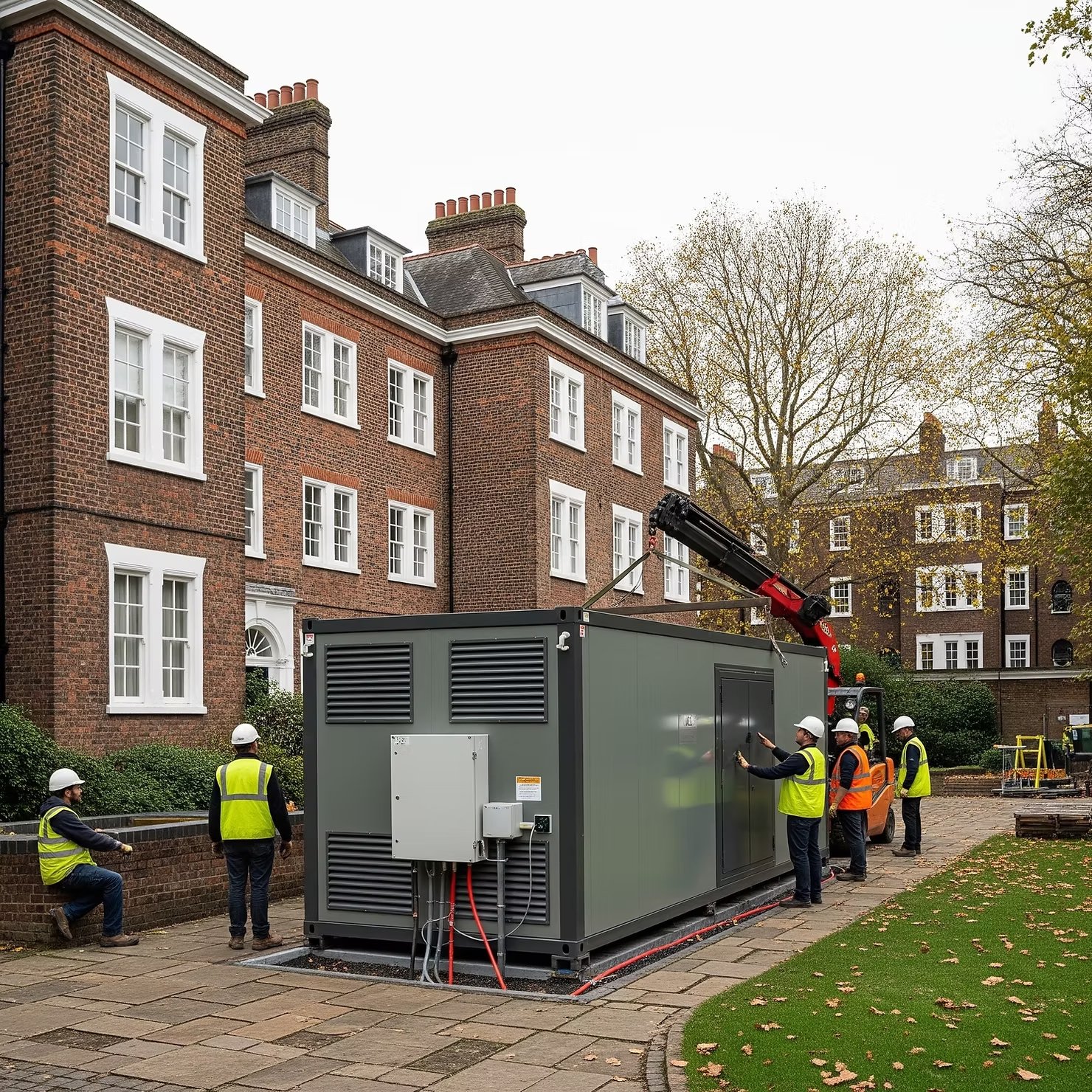
Community batteries allow multiple homes to access stored electricity, for example by capturing excess solar power during the day and using it later. The government states that the exercise forms part of its drive to support locally owned clean energy generation projects.
Energy Minister Michael Shanks said that a more flexible energy system is needed if households are to feel the full benefit of clean power, and that community batteries could give renters and people living in flats the chance to store cheaper renewable electricity and cut their bills.
The government notes that countries including Australia already use community batteries at scale.
The Case Studies
DESNZ published two case studies, which carry the only quantified savings figures in the announcement.
A partnership led by Bridport Cohousing delivered a 54-home net zero development in Bridport, Dorset in 2023. The government states that the development uses a local microgrid combining rooftop solar, battery storage, EV charging and wind, and that by lowering electricity imports and generating export revenues the system reduced energy costs by the equivalent of around £1,300 per home per year.
A community battery was installed alongside existing solar panels at Elmore House, a Lambeth Council-owned block of flats in Brixton, in 2021. The government states that participating households received savings equivalent to around £180 per year during the trial, through a combination of solar generation, battery use and flexibility payments.
The Ledger
Battery storage was the fastest growing power technology in 2025, according to the IEA. Global capacity additions reached 108 GW, up around 40% on 2024, which exceeds the historical peak for gas-fired power capacity additions of around 107 GW in 2002. Installed capacity is now eleven times the 2021 level.
Utility-scale installations accounted for around 87 GW of the 2025 total, around four-fifths. The IEA reports that behind-the-meter deployment also accelerated, particularly in markets with high retail electricity prices and supportive regulatory and policy frameworks.
European figures ran against the global trend. The IEA puts total European battery additions in 2025 at around 6.2 GW, slightly lower than 2024, with a structural shift towards utility-scale systems where additions more than doubled to about 4.6 GW.
Australian deployment is where the behind-the-meter growth appeared. The IEA reports Australian additions surging to nearly 8 GW in 2025, almost nine times the previous year, with utility-scale rising from under 1 GW to around 4.2 GW and behind-the-meter additions increasing from roughly 0.2 GW to about 3.4 GW, supported by state and federal incentives. Battery storage now accounts for around 18% of installed dispatchable capacity in Australia, compared with 7% in China, 5% in the United States and 4% in Europe.
Great Britain already has batteries operating in its power system. The IEA states that wind is the primary driver of changes in net load there, that batteries are expanding their role within an increasingly diversified power mix, and that they are playing a growing role in the balancing mechanism, where speed is particularly valuable for meeting short-term ramping needs.
On the technology likely to be involved, the IEA reports that lithium iron phosphate batteries now account for around 90% of storage deployments globally, being cheaper than rival chemistries used in EVs and better suited to frequent cycling.
The IEA identifies grid connection and permitting as remaining bottlenecks for battery deployment, with non-construction phases often accounting for more than half of total project timelines, and states that regulatory frameworks play a central role in shaping deployment.
Key Figures
Department for Energy Security and Net Zero, press release, 4 June 2026, published under the Open Government Licence v3.0. Source of the call for evidence details, the Michael Shanks quotation and both case studies.
International Energy Agency, Global Energy Review 2026, published 20 April 2026, source of the 108 GW, 40%, eleven times 2021, four-fifths utility-scale and 90% LFP figures.
Brent Wanner, Max Schoenfisch and Hans-Kristian Ringkjøb, Battery storage is scaling up and taking on a larger system role, IEA commentary, 29 May 2026, licensed under CC BY 4.0. Source of the regional, Australian, dispatchable capacity, Great Britain and permitting figures. The IEA attributes its deployment data to Benchmark Mineral Intelligence.
Read next
All insights →


 Newest on The RegisterDr Francisco TrinidadFormer Director of Battery Technology, Exide · Alpha Beta SocietyRead the profile →