What does the US black mass export restriction require?
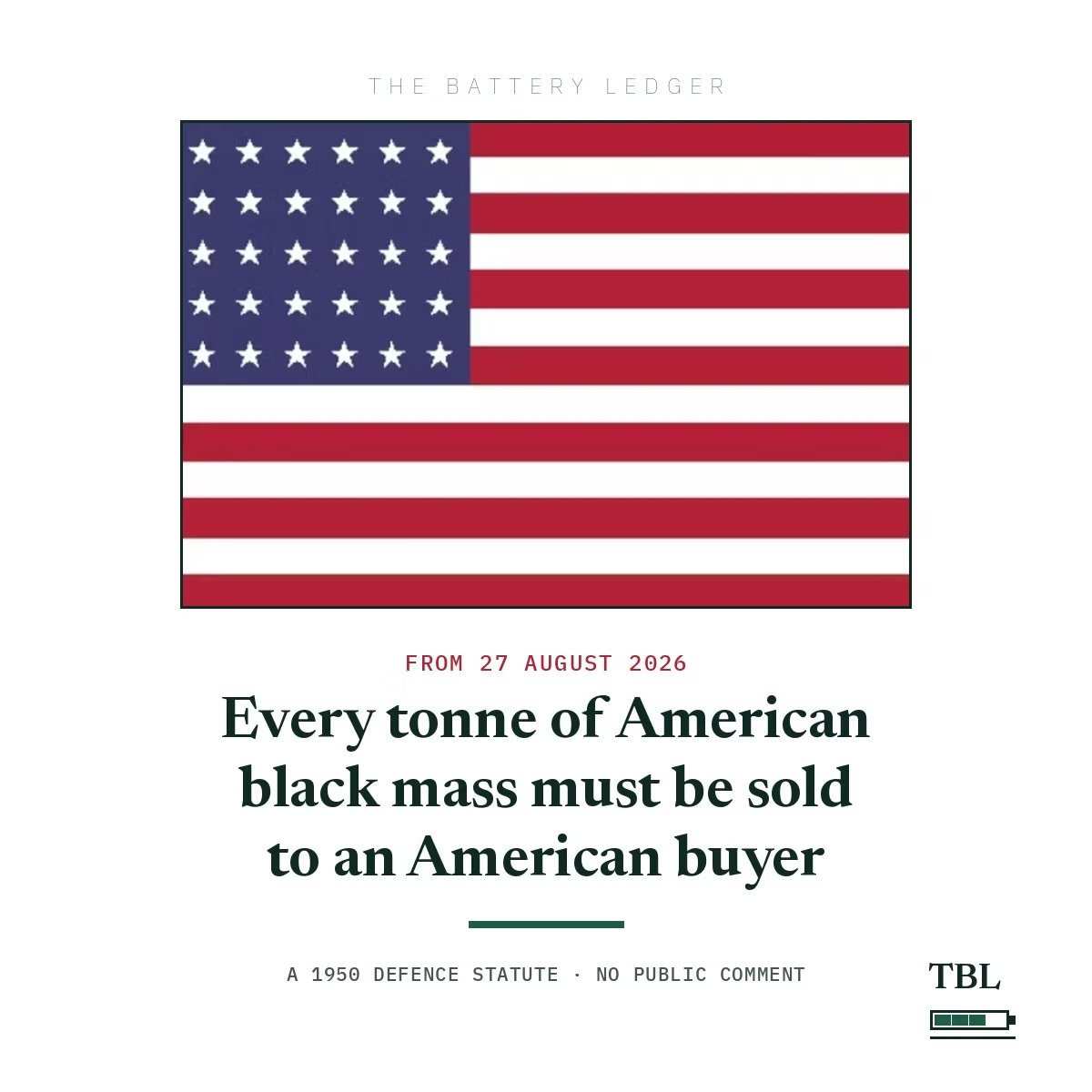
From 27 August 2026 every tonne of American black mass must be sold to an American buyer. The rule was written under a 1950 defence statute and bypassed public comment entirely.
From 27 August 2026, US persons selling black mass or tungsten waste and scrap must allocate 100 per cent of monthly sales to US persons, unless the Bureau of Industry and Security has granted an adjustment or exception in advance.
How it came about
On 30 July 2026 the President issued Determination No. 2026-19 under Section 101 of the Defense Production Act of 1950, finding that certain recoverable critical minerals and materials are scarce and essential to the national defense, and directing the Department of Commerce to secure their supply. It was published at 91 FR 50,465 on 4 August.
On 6 August, BIS published a temporary final rule at 91 FR 50,701, titled DPAS Directive Allocation Order and Additional Requirements for Recoverable Critical Minerals and Materials. It was effective immediately, with the allocation order itself starting 21 days later.
The Defense Production Act allowed BIS to forgo the notice and comment process that the Administrative Procedure Act would normally require. That is the detail worth pausing on: a rule reshaping an entire export market took effect three weeks after it was written, and nobody outside government saw it coming.
What counts as black mass
The rule defines black mass as any shredded lithium-ion battery scrap containing cathode material, including lithium, cobalt, nickel and manganese, anode material such as graphite and silicon, or other residual battery cell materials. Only material falling within the covered Schedule B codes is caught.
Tungsten waste and scrap is covered by the same order, which sweeps in cemented carbide tooling, drill bits, tungsten alloys, high-speed steel scrap, electrical contacts and end-of-life aerospace and defence components.
Toll processing is caught
The arrangement most likely to trip operators up is sending material abroad for processing or refining and bringing the refined product back. That is a sale to a non-US person, and it needs an exception.
Requests for adjustments and exceptions can be submitted on a rolling basis from 6 August 2026 through to 27 August 2027. BIS will enforce the order with US Customs and Border Protection.
Whether the capacity exists
The obvious question is whether American recyclers can absorb material that was previously going overseas. Reporting has put the pre-restriction outflow of electronic scrap at roughly 33,000 tonnes a month, a substantial share of it mineral-bearing battery scrap, while domestic recycling capacity is projected to take between two and four years to double.
If those figures are close to right, the order creates a domestic surplus before it creates the domestic capacity to process it. That is a price story as much as a policy one.
What might come next
The Presidential Determination is broader than the rule made under it. It delegates authority over end-of-life rare earth permanent magnets, swarf, and other waste and scrap containing critical minerals. BIS has invited comment by 4 November on whether sales requirements should extend to further materials.
Black mass and tungsten are the first two. They are unlikely to be the last.
See every other date in the US Battery Compliance Calendar.
Baker McKenzie, BIS restricts exports of black mass and tungsten waste and scrap
Pillsbury, Commerce Department implements export restrictions
National Law Review, new US restrictions on export of black mass
A summary for orientation, not legal advice.
Read next
All insights →


 Newest on The RegisterDr Francisco TrinidadFormer Director of Battery Technology, Exide · Alpha Beta SocietyRead the profile →