What is China’s battery consumption tax?
China is taxing lithium-ion and exempting sodium-ion and solid-state. Both sides of that are new, and the exemption expires in 2028.
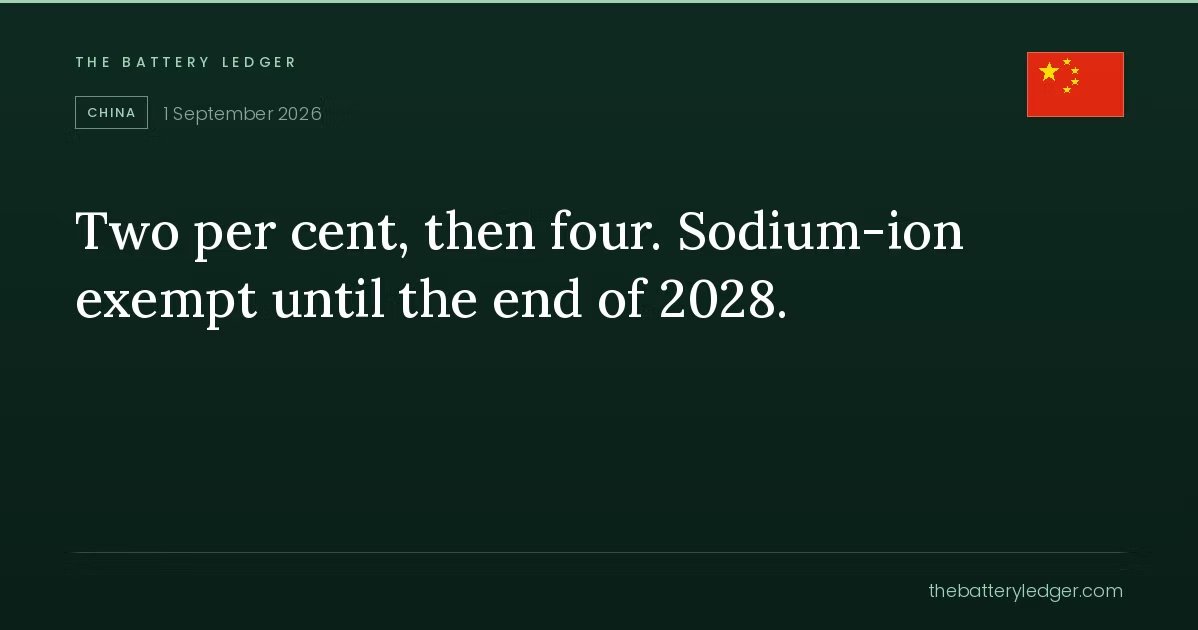
A consumption tax of 2 per cent applies to batteries in China from 1 September 2026, rising to 4 per cent from 1 September 2027.
It was announced on 17 July 2026 by the Ministry of Finance, the General Administration of Customs and the State Taxation Administration, and it is the first substantial revision of the battery consumption tax since it was introduced in February 2015.
What is taxed
The 2 per cent rate applies to mercury-free primary batteries, nickel-metal hydride batteries, lithium primary batteries, lithium-ion batteries and all-vanadium redox flow batteries.
The 4 per cent figure is not arbitrary. It is the standard consumption tax rate that has technically applied to batteries since 2015 and that lead-acid batteries have been paying throughout. What changed in 2015 was not the rate but the exemption list, and what has changed now is that most of that list has been removed.
The exemption is the substance
Sodium-ion batteries, solid-state batteries and fuel cells are exempt from 1 September 2026 to 31 December 2028, together with perovskite, tandem and gallium arsenide photovoltaic cells.
The detail that gives this its force is easy to miss. Sodium-ion and solid-state were not on the 2015 exemption list and have been paying the full 4 per cent ever since. This announcement does not preserve an advantage they already had. It creates one.
So the gap between lithium-ion and sodium-ion moves from zero to four percentage points over twelve months, in the market that manufactures most of both. That is industrial policy written into the tax code, at exactly the point China is scaling sodium-ion production.
The cliff edge nobody is planning for
The exemption is dated. It runs out on 31 December 2028, and unless it is extended, the exempt chemistries move onto the standard rate from 1 January 2029.
That gives sodium-ion and solid-state a twenty-eight month window in which to reach cost parity with a four per cent handicap removed. It is a deadline for commercialisation as much as a tax concession.
What it means outside China
Analysts have noted that exported batteries are expected to fall outside the scope of the consumption tax, which limits the effect on manufacturers with high overseas revenue. The measure therefore bites hardest on domestic sales, and its clearest international consequence is the relative signal it sends about which chemistries Beijing intends to back.
See every other date in the Asia Battery Compliance Calendar.
A summary for orientation, not legal advice. Regulation across Asia is moving quickly; confirm against the primary source before acting.
Read next
All insights →
 Newest on The RegisterDr Francisco TrinidadFormer Director of Battery Technology, Exide · Alpha Beta SocietyRead the profile →