Solid State Battery Rules – An Opportunity.
China has taken the lead on the first international rules for solid-state electric-vehicle batteries. The step is real, and narrower than most of the coverage suggests.
Solid-state batteries are among the technologies the car industry is working hardest to develop. The aim is to replace the flammable liquid inside a conventional battery with a solid material, which should allow a battery to hold more energy, giving electric cars greater range, and to reduce the fire risk associated with that liquid. None are yet made at large scale, but most serious carmakers and battery producers are pursuing them.
In August, it was widely reported that China had set the world’s first international standard for these batteries. The reports were broadly right about the direction and imprecise about the substance, and the substance is what matters.
What was actually decided
China did not publish a finished international standard. It secured approval to begin developing one.
The International Electrotechnical Commission, or IEC, is the body that develops shared technical standards for electrical products internationally. In August it approved a Chinese proposal as a new work item, meaning the process of developing the standard has formally begun, with China leading it and experts from France, Japan and South Korea taking part. Beginning the work is a genuine step. It is not a finished rule, no carmaker has adopted it, and an IEC standard is something manufacturers choose to build to rather than something they are required to use.
The distinction matters. A rule a single country writes for its own market and a standard many countries ratify are different instruments, and treating the first as the second overstates how settled the position is. What has been agreed is that the work will proceed under Chinese leadership. The eventual influence of the standard will depend on the technical text it produces, on which countries remain engaged, and on whether the industry adopts it in practice.
A definition of “solid-state”
Separately from the international project, China introduced its own national standard on 1 July, which does something useful in its own right. It sets out what “solid-state” means.
The term has long been applied loosely. Many batteries marketed as close to solid-state are in fact partly liquid inside. The national standard distinguishes three categories: conventional batteries with a liquid electrolyte, hybrid cells that are part solid and part liquid, often sold as “semi-solid”, and fully solid cells. It uses a measurable test to separate them, so that a battery either meets the threshold for the top category or does not. A marketing term becomes a verifiable one.
This is useful beyond China. A shared, measurable definition gives manufacturers a clear target, gives buyers a means of checking a claim, and removes some of the ambiguity from a field that has relied on optimistic language. A firm in the United States or Germany building a genuinely solid cell now has a defined line to demonstrate it has crossed, and a way to distinguish its work from a competitor’s claims. That the first such definition came from China concerns who completed the standard first, not who will build the best battery.
Why the position remains open
A “China first” headline invites the assumption that the contest is settled. The evidence indicates it is early.
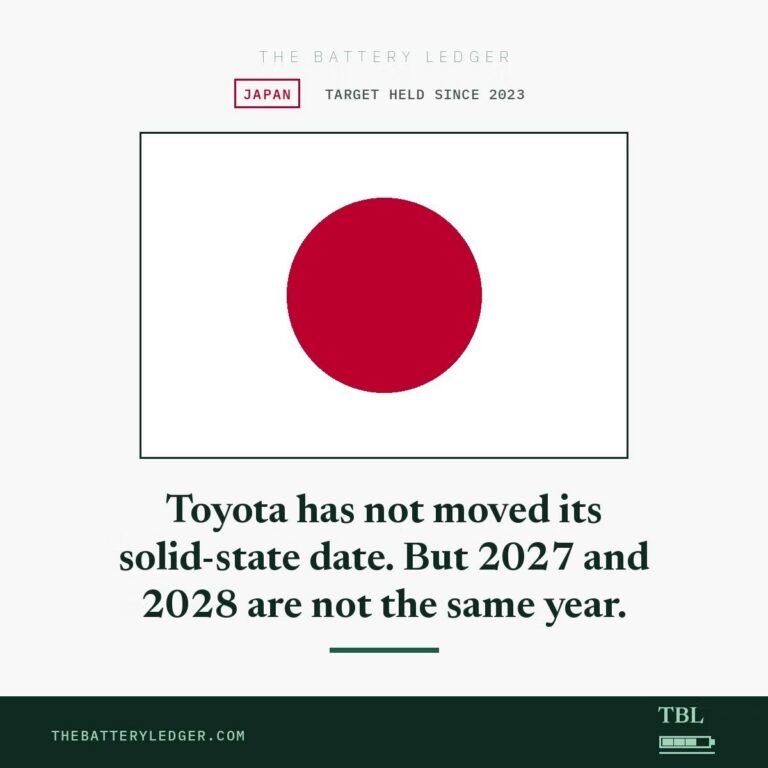
Patents offer one measure of standing, since they show who owns the underlying inventions. On the raw counts no single country dominates: China and Japan file the most, with the United States and South Korea not far behind. But patent counts are an imperfect guide, and volume is not the same as strength. By the assessment of several patent analysts, Japanese firms hold particularly strong positions, with Toyota commonly identified as the single largest holder, and Chinese firms, despite filing heavily at home, tend to protect their inventions in fewer other countries than their Japanese and South Korean counterparts. On any reading, ownership of the technology is distributed across several countries rather than concentrated in one.
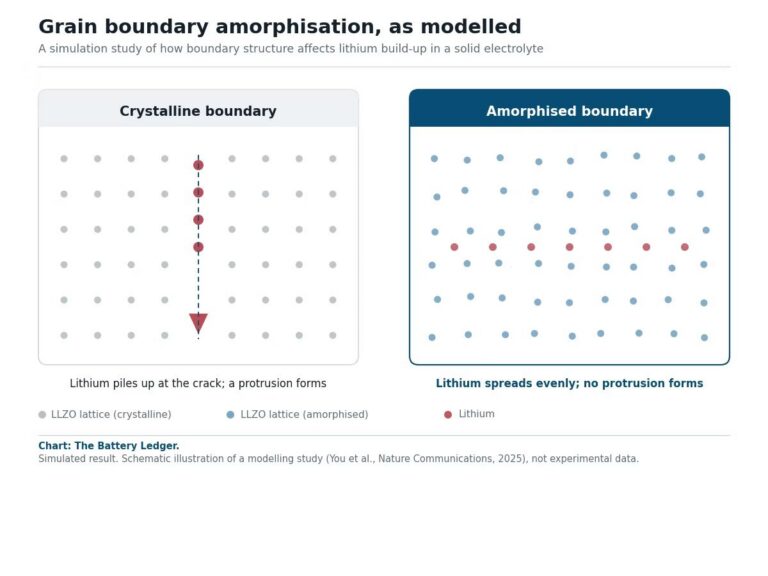
The engineering is also unsettled. The basic science is understood; the open question is whether a particular recipe for the solid material, and a particular means of manufacturing it, can deliver the full combination required at once: sufficient energy, adequate lifespan, acceptable cost, and reliability, at the scale a car factory demands. Several approaches are in contention and none has prevailed. These problems are unresolved for everyone, and Western research institutions and start-ups are working on the same questions.
China’s advantage is specific: scale and speed. Its approach is to commercialise the hybrid “semi-solid” cells first, since they can be made on existing production lines, and to move to fully solid cells later, supported by the world’s largest market for electric cars. Pilot-scale production is under way and prototype cells exist. Large-scale manufacturing of fully solid cells is generally expected to begin around 2027 at the earliest, with wider use later, and those dates are industry expectations rather than commitments.
What this does not establish
The international standard is at the start of its development, not finished or adopted; its final content and influence remain to be determined. Figures on patents and production timelines are drawn from public reporting and industry assessments, which use differing definitions and are subject to change.
The Ledger
Taken together, the developments describe a field maturing rather than a race concluding. A shared definition of “solid-state” now exists, which serves everyone working honestly. The first international standard project has begun, which merits attention but is not yet a settled global rule. And the hardest elements, the chemistry and the manufacturing, remain open, with significant expertise spread across several countries.
My reading is that a standard is a document, and a battery is something built in a factory, and the distance between the two is considerable. That distance is where the outcome will be decided. The firms that gain most from a clearer set of rules are those with a real product to measure against them.
The more useful question, then, is not who wrote the first draft of the rules, but who will be first to build a battery that meets them at scale.
Sources
State Administration for Market Regulation (SAMR) statement on the IEC new work item, August 2026, as reported by the South China Morning Post and others. China’s national standard GB/T 43568-2026 on solid-state battery terminology and classification, effective 1 July 2026, as reported across trade coverage. Patent-landscape assessments from PatSnap and reporting via CarNewsChina on national filing volumes and leading holders. Commercialisation timelines from industry roadmaps and trade reporting.
Read next
All insights →
 Newest on The RegisterDr Francisco TrinidadFormer Director of Battery Technology, Exide · Alpha Beta SocietyRead the profile →