Simulations Point To Grain Boundary Engineering As A Route To Mitigating Dendrites In Solid-State Batteries
Modelling suggests deliberately melting the boundaries between crystal grains could suppress the dendrites that threaten solid-state cells.
Source: Nature Communications, open access.
Solid-state lithium battery research is moving towards precision control of internal microstructure, as computational work examines how defects at the boundaries between crystal grains govern the lithium behaviour that limits battery safety and stability.
A study published in Nature Communications on 19 May 2025 by You and colleagues at the Department of Physics, Xiamen University, examines how grain boundaries in garnet-type lithium lanthanum zirconium oxide, or LLZO, drive uneven lithium distribution and dendrite formation.
The work is computational throughout. The authors used machine learning interatomic potentials trained with the DeePMD-kit package, molecular dynamics simulations run in LAMMPS, and density functional theory calculations in VASP. No experimental cells were built or tested. The findings are modelling results, and the paper presents them as a theoretical basis for designing solid electrolyte microstructures rather than as validated performance.
What The Simulations Found
Lithium does not distribute evenly across a grain boundary. The authors report that lithium either accumulates at or is depleted from the boundary, driven by the system minimising its energy, and that which of the two occurs depends on the local lithium cavity fraction. Higher cavity fraction means more lithium is drawn in.
Boundary orientation matters as well. Modelling a full cell of lithium metal, LLZO electrolyte and a lithium zirconium oxide positive electrode, the authors found that a cell with no grain boundary showed the fastest lithium diffusion, and that a boundary lying parallel to the electrolyte interface slowed diffusion most.
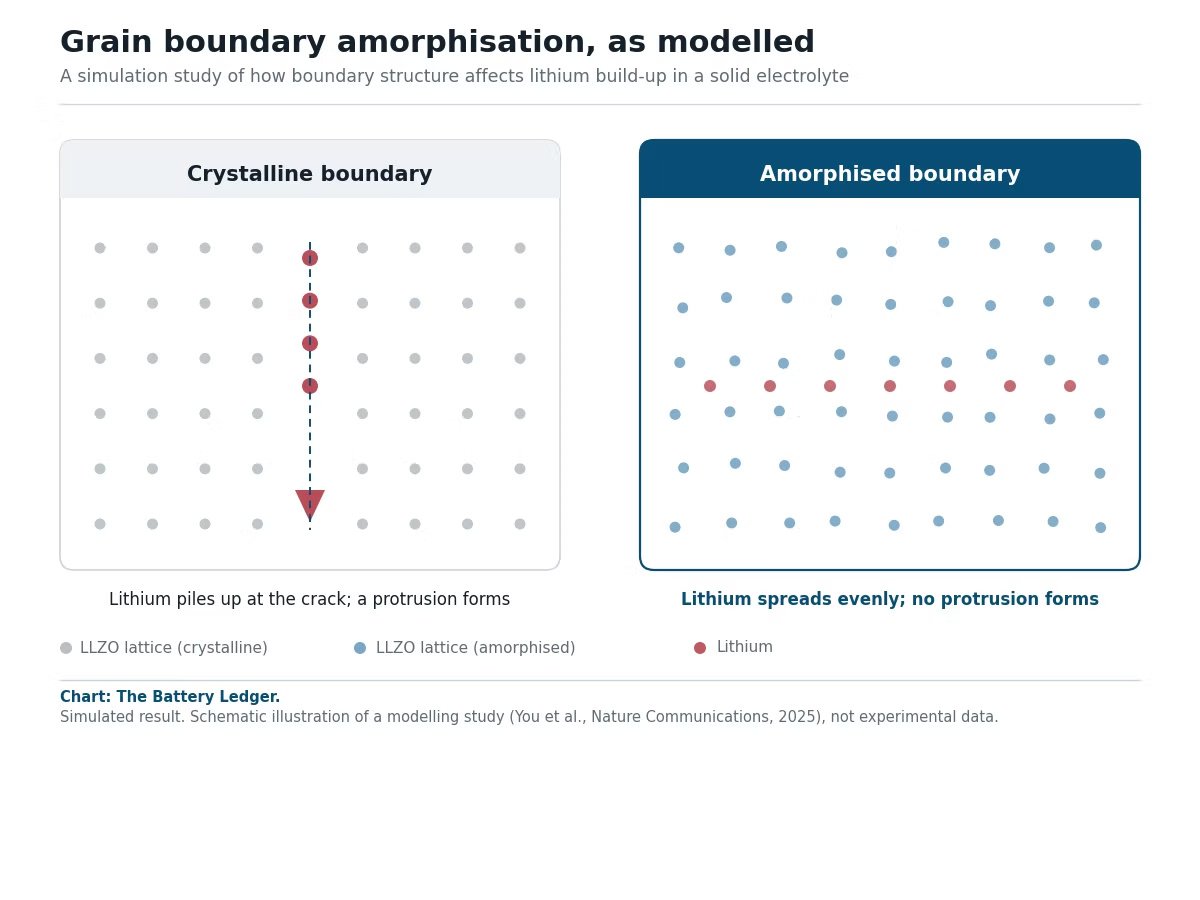
In a model with a larger cavity fraction, a protrusion appeared at the electrolyte and lithium metal interface after 0.5 nanoseconds of simulated time, developing into a conical region by 2 nanoseconds. No such feature appeared in the model without a grain boundary. The authors identify these crack-like boundary voids as facilitating lithium protrusions and dendrite formation in their model, which they associate with increased short-circuit risk.
The Ledger
The proposed intervention is selective melting. The authors report that heating drives preferential melting at the grain boundaries, because those regions are less stable than the bulk, which converts them to an amorphous phase while the surrounding crystal structure survives. In their simulations, energy stabilised at 800 K, while at 1800 K a continuing energy increase was taken to suggest ongoing crystal-to-amorphous transformation.
In the amorphised model, the authors report a more uniform distribution of lithium, with the interfacial protrusion absent. This is a simulated outcome for the modelled system, not a measured result in a fabricated cell.
Two mechanisms are offered, both derived from the simulations. Mechanically, the modelled crystalline grain boundary structure cracked at under 10% strain, while the amorphous version withstood 15%, which the authors argue would better accommodate the strain of lithium transport and insertion. Electronically, the calculated charge density at the boundary and lithium interface was significantly higher than elsewhere, whereas the amorphised structure distributed charge more evenly, which the authors interpret as producing more uniform lithium reduction.
There is a cost, and the paper states it plainly. Amorphisation slightly reduces ionic conductivity, because amorphous LLZO conducts lithium ions less well than the crystalline form. The argument is that the gain in interfacial stability outweighs that loss, not that the modification is free.
For the industry, the significance is directional rather than immediate. This is atomistic modelling of a materials problem that has resisted experimental characterisation, which the authors note is precisely why simulation was used. Whether controlled grain boundary melting can be achieved in manufactured cells, at scale and at cost, is a separate question that this work does not address.
Key Figures
You, Y., Zhang, D., Wu, Z., Lü, T.-Y., Cao, X., Sun, Y., Zhu, Z.-Z. and Wu, S. Grain boundary amorphization as a strategy to mitigate lithium dendrite growth in solid-state batteries. Nature Communications 16, 4630 (2025). DOI: 10.1038/s41467-025-59895-9. Published 19 May 2025, open access under CC BY-NC-ND. Funded by the National Natural Science Foundation of China, the Natural Science Foundation of Xiamen, and the Fundamental Research Funds for the Central Universities.
Read next
All insights →

 Newest on The RegisterDr Francisco TrinidadFormer Director of Battery Technology, Exide · Alpha Beta SocietyRead the profile →