Silicon’s Engineering Is Finally Catching Up to Its Promise
Silicon has promised denser, longer-range batteries for a decade, but its tendency to swell kept it out of the mainstream. In 2025 and 2026, the engineering may finally be catching up. Here is where it actually stands.
The case for silicon has always been clear. It can hold far more lithium than the graphite used in most battery anodes today, as much as ten times more by weight, which means a denser battery: longer range, smaller packs, faster charging. The theory was never the problem. The engineering was.
For a decade, silicon has been described as the industry’s next big step, always a year or two away. Amprius was shipping small volumes of high-silicon cells as far back as 2018. Sila put its material into a consumer product, the Whoop band, in 2021. Porsche announced in 2022 that it would produce silicon cells with Group14’s technology from 2024. Each milestone carried the same suggestion: the graphite era was ending. Each time, the shift arrived more slowly than expected. The reason is worth understanding, because it says a lot about how battery technology actually moves.
The problem that took a decade to answer
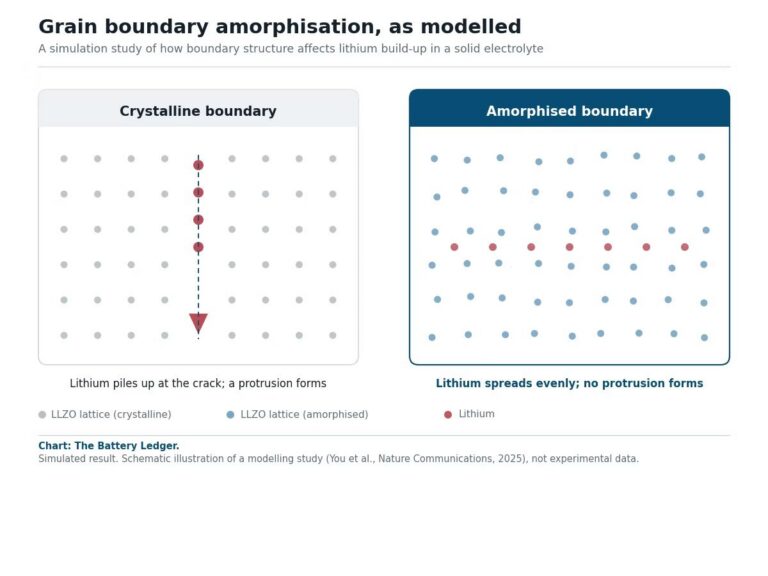
Silicon’s strength is also its difficulty. When it absorbs lithium, it swells, by as much as 300 per cent. Graphite barely moves. Silicon expands and contracts with every charge, and that repeated strain cracks the electrode, loosens its contact with the rest of the cell, and shortens the battery’s life. The more silicon you add, the harder the problem becomes.
This is why most commercial lithium-ion anodes today contain only a few per cent silicon, often as silicon oxide: a small addition to graphite for a modest gain, rather than a replacement. The idea of a silicon-dominant anode was never in doubt. Making one that lasted was.
What has changed
The development worth noting, and it is a real one, is that in 2025 and 2026 the engineering has begun to catch up with the chemistry. The approach, broadly, is to give silicon room to move. Group14 and Sila build porous carbon structures that hold the silicon and let it expand at a microscopic scale without damaging the electrode. Amprius grows silicon into nanowires that better tolerate the strain. Different methods, the same goal: contain the swelling, keep the capacity.
And the work is leaving the laboratory. In March 2026, Group14 began what it describes as EV-scale production of its SCC55 material at a new plant in Sangju, South Korea, built for up to 2,000 tonnes a year, which the company puts at around 10 GWh of battery capacity as it ramps. Sila, which opened its Moses Lake plant in Washington State in late 2025 and is shipping sample material, raised a further $300 million this year to expand it. Amprius is supplying near-pure silicon cells, at cell-level energy densities high enough to matter, to aerospace, drone and defence customers who will pay for every gram saved. These are the companies’ own figures, and the plants that will prove them at full scale are still ramping. But this is material leaving the building, not a plan for a future one.
Why progress still looks gradual
Scaling and winning, though, are not the same thing, and three points sit beneath the good news.
Cost is the first. Silicon-carbon anode material still costs several times more than graphite per kilogram. That gap is expected to narrow as the new plants reach scale, but parity remains some years off on most projections, and in a price-driven industry, that matters.
The route to market is the second. Silicon is arriving first where energy density is worth paying for, aerospace, drones, defence, premium electronics, rather than in the mass-market electric car. In EVs, it is still mostly appearing as a few extra percentage points in a largely graphite anode.
And the hardest part is the last. Containing silicon’s expansion at low content is close to solved. Doing it at high content, over thousands of cycles, at automotive scale and automotive cost, is where the real work remains.
Room for more than one answer
None of this diminishes silicon, or the companies backing it. Their progress is real, and producing this material at genuine scale, after years of trying, is a considerable achievement. The point is that the battery industry is rarely winner-take-all. Graphite is not being replaced so much as joined. Silicon will take the applications that reward its density; other chemistries will keep theirs. The anode of the next decade looks less like a single winner and more like a range, more silicon in some cells, less in others, chosen for the task.
Where it leaves us
Silicon is not a false promise. It works, and it is now being made at scale. But it is not the sudden replacement the coverage has often implied, either. It is arriving as most real technology shifts do: steadily, unevenly, in the markets that can afford it first, in small volumes before large ones.
That it keeps seeming to almost arrive is, in the end, because it is arriving, just not as quickly, or as completely, as each year’s headlines suggest. And it is worth watching, because the companies learning to make it at scale now are the ones best placed when the cost comes down.
The Ledger
The wider lesson is not really about silicon. It is about how to read the industry’s breakthroughs. The chemistry is usually proven years before the manufacturing, and the manufacturing years before the cost. “It works in a cell” and “it is in your car at a price you will pay” are separated by a long, unglamorous middle, and that middle is where most of the real work, and most of the waiting, happens. Silicon has travelled further along it than ever. It has not reached the end.
Amprius’s early high-silicon shipments, Sila’s 2021 Whoop product, and Porsche’s 2022 announcement targeting silicon-cell production from 2024, from company announcements and contemporaneous reporting (these were announced targets). Group14’s EV-scale production at Sangju, South Korea (announced 12 March 2026; up to 2,000 tonnes a year, around 10 GWh, company figures) from Group14, PRNewswire and TechCrunch. Sila’s Moses Lake plant (operational from late 2025, shipping sample material) and its $300 million raise (2026) from GeekWire. Amprius’s high-energy-density silicon cells supplied to aerospace and drone customers (cell-level figures, as stated by the company). The roughly 300 per cent swelling figure and the few-per-cent silicon content in most commercial anodes today from established industry sources. Cost remains above graphite, with parity projected some years out. Written from the public record; company performance figures are as stated by the companies.
Read next
All insights →
 Newest on The RegisterDr Francisco TrinidadFormer Director of Battery Technology, Exide · Alpha Beta SocietyRead the profile →