cylib Named a Strategic Project in Europe’s Push for Materials Security
The European Commission has selected cylib’s battery recycling project as a Strategic Project under the Critical Raw Materials Act. It is a sign of how far the business of recovering battery materials has moved, from an environmental good to a matter of European strategy.
The European Commission does not apply the label lightly. On 14 October it named cylib’s battery recycling project a Strategic Project under the Critical Raw Materials Act, the European Union’s framework for securing the materials its industry cannot afford to depend on others for. cylib is among a small number of German projects selected across the Union in this round.
For a company founded in 2022, spun out of research at RWTH Aachen, it is a remarkable place to have arrived in a short time, and a deserved one. And it says something about where the battery industry’s priorities now sit.
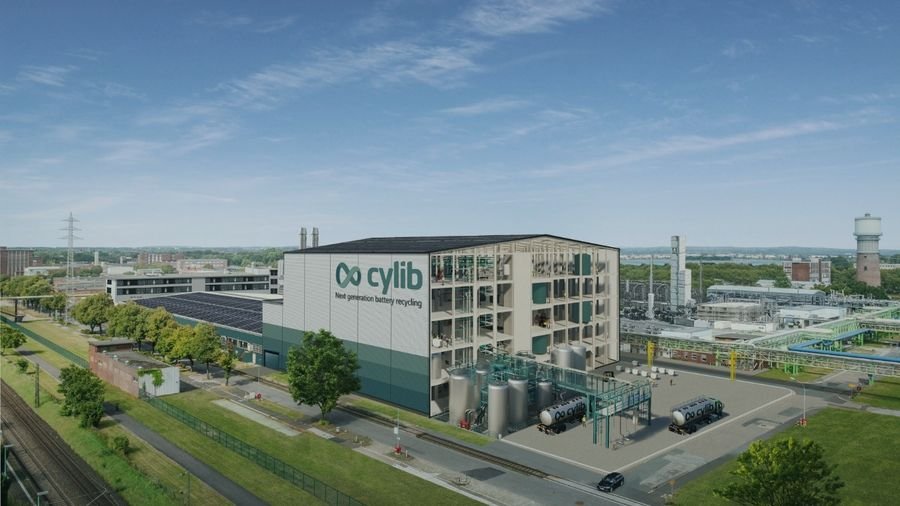
cylib’s hydrometallurgical facility in Dormagen, under construction. Image: cylib
What the designation recognises
At the centre of it is cylib’s hydrometallurgical facility in Dormagen, currently under construction and designed to process up to 140,000 electric-vehicle batteries a year. It is one part of an integrated German network: research and development at the Aachen headquarters, mechanical processing in Bavaria, and the industrial-scale recovery planned for Dormagen.
The Commission selects Strategic Projects for a specific purpose: their potential to strengthen Europe’s supply of strategic raw materials and reduce its dependence on any single third country. Battery recycling fits that logic closely. The Critical Raw Materials Act sets a target that only industrial-scale plants can meet, recovering, through recycling, at least a quarter of the EU’s annual consumption of strategic raw materials by 2030. Facilities like Dormagen are how a target on paper becomes material in practice.
From sustainability to strategy
The more interesting point is what the designation represents. For most of the past decade, battery recycling was framed as an environmental good, the responsible thing to do with a spent pack. The Strategic Project label reframes it as something with a harder edge: a question of industrial security. Recovering lithium, nickel, cobalt, manganese and graphite inside Europe means fewer of those materials have to be bought from concentrated supply chains elsewhere.
That shift in framing is the real significance of the news. As Dr Lilian Schwich, cylib’s Co-CEO and co-founder, puts it, a battery’s first life does not have to be the end of its value in Europe. It is the kind of conviction that has carried cylib from a university spin-out to a name on Europe’s strategic map in barely three years.
The technology behind it
cylib’s recovery process, which it calls OLiC, is water-based. The company reports recovery rates above 90 per cent for lithium, graphite, nickel, cobalt and manganese, with a carbon footprint it puts at around 80 per cent lower than primary extraction. Those are cylib’s own figures, and the plant that will demonstrate them at industrial scale is still being built. But the direction is the point: a genuinely European route from used batteries back to usable materials, and one the Commission has now judged important enough to back.
A signal from Berlin
The designation drew a welcome from Stefan Rouenhoff, Parliamentary State Secretary at Germany’s Federal Ministry for Economic Affairs and Energy, who called it an important signal for Germany as an industrial location and for the resilience of European value chains. That a federal minister reaches for a recycling project to make that point is itself a measure of how the politics of materials has changed.
The Ledger
cylib is young, its flagship plant is still under construction, and the figures that will matter most, qualified output, and materials actually returned to European industry, are still ahead of it. None of that is hidden. But for a company barely three years old to be named part of Europe’s critical infrastructure is a genuine mark of how much it has built, and how seriously the continent now takes the business of making its batteries twice.
Recovering what Europe has already mined, once, has stopped being a nice idea and started being a strategy. cylib has earned its place on that map.
cylib’s selection as a Strategic Project under the EU Critical Raw Materials Act (announced 14 October 2026); the Dormagen hydrometallurgical facility (under construction, designed for up to 140,000 EV batteries a year); cylib’s integrated German network (Aachen research and development, Dormagen processing, Bavaria mechanical processing); the CRMA 2030 target (at least 25 per cent of EU strategic raw materials consumption from recycling); the OLiC technology (recovery rates above 90 per cent, around 80 per cent lower carbon footprint, company figures); cylib’s founding (2022, Aachen, from RWTH Aachen; co-founders Dr Lilian Schwich, Paul Sabarny, Dr Gideon Schwich); and the statement from Stefan Rouenhoff (BMWE). From cylib’s press release and the European Commission’s announcement. Written from the public record.
Read next
All insights →
 Newest on The RegisterDr Francisco TrinidadFormer Director of Battery Technology, Exide · Alpha Beta SocietyRead the profile →