Who Is Buying Lead Recycling, and Who Is Selling
European battery makers are buying secondary lead smelters. A Chinese storage company is selling one, and has explained why.
Sources: European Commission, Clarios, Ecobat, Campine via Euronext, Narada Power via EnergyTrend, and USGS Mineral Commodity Summaries 2026.
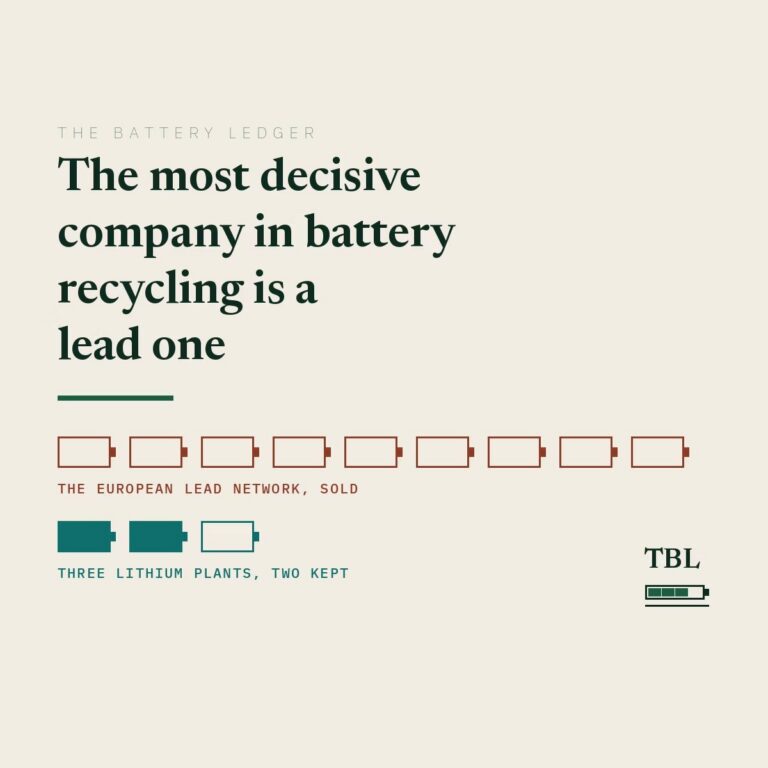
Two contrasting transactions took place in the lead battery recycling sector during the twelve months to July 2026. In Europe, battery manufacturers expanded their ownership of secondary lead recycling assets. In China, an energy storage company announced plans to divest its lead recycling business and explained why.
Viewed together, the transactions illustrate different strategic responses to the changing battery market.
The Buyers
Clarios completed its acquisition of three secondary lead recycling smelters from Ecobat on 4 May 2026. The facilities are located at Freiberg and Braubach in Germany and Arnoldstein in Austria. The European Commission approved the transaction unconditionally in April 2026 following notification on 4 March.
The Commission’s decision provides useful context. It describes Clarios as a vertically integrated manufacturer of automotive lead-acid batteries that also produces secondary lead and lead alloys, using that output entirely within its own battery manufacturing operations. Ecobat’s three smelters, by contrast, supplied secondary lead, lead alloys and polypropylene to battery manufacturers on the open market.
Before completing the acquisition, Clarios already operated secondary lead recycling facilities in Germany and Spain.
Campine also expanded its recycling footprint. On 1 October 2025 it completed the acquisition of Ecobat’s French lead operations, including battery recycling plants at Bazoches-les-Gallerandes and Pont-Sainte-Maxence together with a semi-finished lead products facility at Estrée-Saint-Denis. Campine stated that the acquisition added approximately 70,000 tonnes of battery recycling capacity, producing around 40,000 tonnes of lead alloys annually, while contributing to group revenue of €766 million in 2025.
Ecobat’s Repositioning
The Clarios transaction completed Ecobat’s disposal of its European lead recycling operations. Ecobat stated that the sale of the German and Austrian facilities, together with previously completed divestments in France, Italy and the United Kingdom, marked the completion of a broader repositioning of its Resources business.
Following those transactions, Ecobat describes itself as a North American platform focused on battery recycling and resource recovery alongside its global lithium-ion business.
Ecobat also continues to describe itself as the world’s largest battery recycler.
A Different Decision In China
Narada Power announced a major asset restructuring on 12 March 2026, including plans to divest its lead recycling subsidiary, Huabo Renewable Resources.
According to the company’s announcement, the divestment is intended to allow greater focus on lithium-ion energy storage, including applications serving AI data centres. Narada said the strategic fit between its lead recycling business and its wider business had weakened as energy storage technologies increasingly shifted towards lithium-ion.
The assets involved are substantial. Huabo’s subsidiaries have been reported as processing approximately 1.2 million tonnes of waste lead batteries and lead-bearing waste each year, producing around 590,000 tonnes of secondary lead. The transaction has been reported as returning approximately RMB 2.565 billion to Narada through a combination of the equity transfer and repayment of financial assistance.
Narada’s decision should not be interpreted as representing the wider Chinese lead industry. It reflects one company’s strategic priorities rather than an industry-wide shift.
Leoch’s reported financial results nevertheless suggest challenging conditions within parts of the Chinese lead recycling market during the same period. The company reported a 20% year-on-year decline in lead recycling revenue to approximately RMB 1.7 billion, attributing the fall to regulatory changes, market conditions and the removal of a government subsidy. Leoch also said it expected profitability to improve under extended producer responsibility rules that require higher recycling rates and stronger enforcement against unregulated recyclers. These observations come from Leoch itself and have not been independently verified for the wider market.
The Regulatory Backdrop
Regulation (EU) 2023/1542 establishes progressively higher recycling requirements for lead-acid batteries. Recycling efficiency must reach 75% by the end of 2025 and 80% by the end of 2030. Lead material recovery targets increase to 90% from 31 December 2027 and 95% from 31 December 2031.
The most significant long-term requirement for manufacturers arrives later. From 18 August 2031, industrial, SLI and electric vehicle batteries placed on the EU market must contain at least 85% recycled lead. Among the recycled-content requirements contained in the Regulation, lead carries the highest threshold.
What The Sources Do Not Establish
The cited sources do not state that the European acquisitions were motivated by the recycled-content requirements that take effect from 2031.
The purchase price paid by Clarios has not been disclosed in the cited material.
The reporting reviewed does not identify the eventual buyer of Narada’s recycling assets.
Similarly, while Leoch attributes improving prospects to evolving Chinese recycling regulation, the broader impact of those policy changes across the industry cannot be established from the available sources alone.
The Ledger
The reporting above is drawn from the cited sources. The observations below are Battery Ledger’s own analysis.
The European transactions appear consistent with a strategy of increasing control over recycled lead supply rather than relying solely on purchases from the open market. The European Commission’s finding that Clarios consumes its recycled lead internally is particularly notable because the acquisition brings facilities that previously supplied multiple manufacturers into the ownership of a battery producer.
Neither Clarios nor Campine has publicly linked their acquisitions to the EU’s recycled-content requirements, and no such motivation is stated in the cited documents. Nevertheless, greater control over recycled lead production could become strategically valuable ahead of the 2031 requirement that qualifying batteries placed on the EU market contain at least 85% recycled lead.
Narada’s decision reflects a different strategic judgement. The company’s stated rationale concerns business focus rather than the quality of the recycling assets themselves. Its explanation centres on the changing direction of stationary energy storage, where lithium-ion has become the dominant chemistry. It does not imply that lead-acid batteries are losing their established positions in applications such as starting, lighting and ignition (SLI), industrial standby power or many motive power applications.
Taken together, these transactions may be less contradictory than they first appear. European battery manufacturers are integrating recycled lead production more closely into battery manufacturing, while Narada is reallocating capital towards lithium-ion energy storage. Both strategies are compatible with the view that lead’s strongest long-term position lies in applications where it already enjoys established market leadership rather than in segments where lithium-ion has become the dominant technology. Whether that proves to be the industry’s long-term direction remains an open question.
Read next
All insights →
 Newest on The RegisterDr Francisco TrinidadFormer Director of Battery Technology, Exide · Alpha Beta SocietyRead the profile →